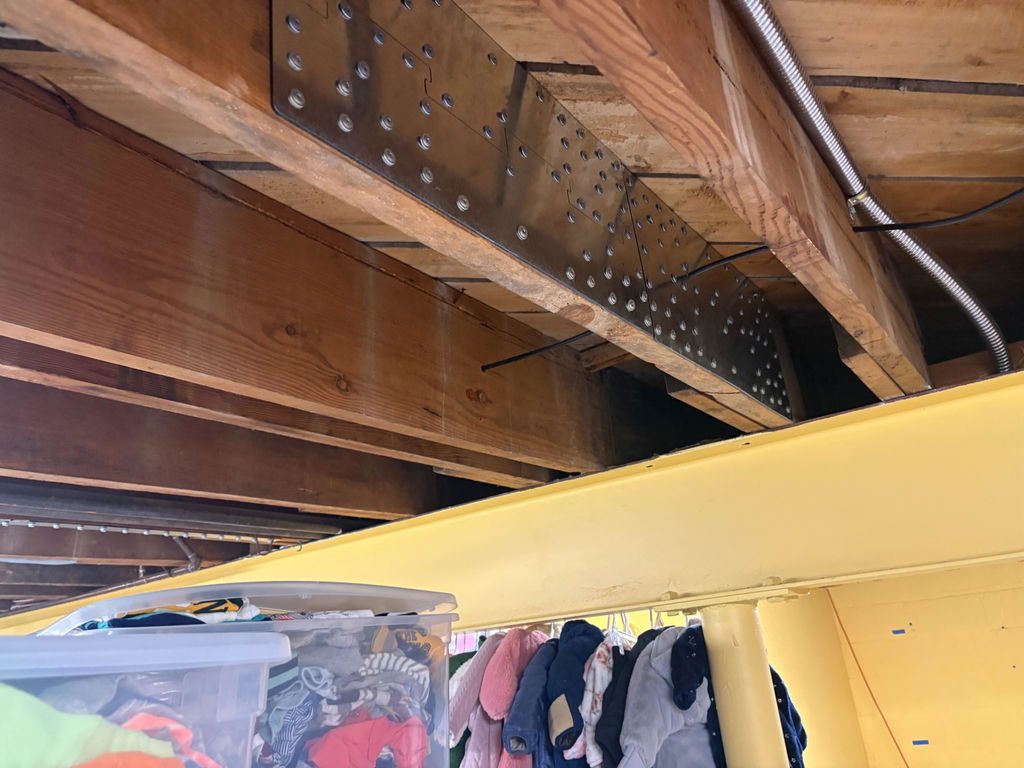
Can Joist Stiffening Straps Reduce Floor Bounce?
Share
Nolan Floor Joist Stiffening Straps can reduce kitchen or bathroom floor bounce when joist flex is the actual problem and the floor framing fits Nolan’s current design information. The calculations report theoretical deflection reductions of 35% to 54% and measured reductions of 15% to 53%, depending on joist size; those results do not establish added allowable load capacity.
- Floor Joist Stiffening Straps address joist stiffness and deflection, not localized damage or failed supports.
- Reported theoretical deflection reduction ranges from 35% to 54% by joist size.
- Reported measured reduction ranges from 15% to 53% and must remain separate from theory.
- The system uses the same physical strap components as Nolan Roof Rafter Strengthening Straps but a separate floor application.
- Do not treat reduced floor bounce as proof of increased allowable load capacity.
Can Floor Joist Stiffening Straps reduce floor bounce?
Yes, when the movement comes from flex in qualifying dimensional-lumber floor joists and the system is selected for the actual framing. The Floor Joist Stiffening Strap System places galvanized A36 steel along the bottom of the joist, where the steel contributes to the reinforced section’s stiffness.
A moving tile surface, rattling cabinet contents, or springy walking feel does not identify the cause by itself. Before selecting the product, document:
- Joist size and material.
- Joist spacing and clear span.
- Condition of the joists and their supports.
- Location of the noticeable movement.
- Existing sag, splits, notches, holes, decay, or previous repairs.
- Plumbing, wiring, ducts, blocking, bridging, and ceiling obstructions.
- Permanent fixtures and other loads supported by the floor.
The Floor Joist Stiffening Strap System addresses stiffness and deflection in otherwise qualifying joists. It is not the Joist Repair Kit and must not be presented as a repair for damaged, notched, or drilled joists unless current floor-specific Nolan documentation expressly permits that condition. It does not correct loose subfloor fastening, failed bearing, a deficient beam, settlement, or another source of movement.
What performance does the report show?
The governing Floor Joist Stiffening Strap design report gives theoretical stiffness increases and both theoretical and measured deflection reductions:
| Joist Size | Reinforced Stiffness Ratio | Theoretical Deflection Reduction | Measured Deflection Reduction |
|---|---|---|---|
| 2 × 4 | 2.20 | 54% | 49% |
| 2 × 6 | 1.92 | 48% | 53% |
| 2 × 8 | 1.77 | 43% | 31% |
| 2 × 10 | 1.64 | 39% | 15% |
| 2 × 12 | 1.55 | 35% | 20% |
Keep the theoretical and measured columns separate. For example, the report lists a 39% theoretical reduction for a 2 × 10 member but a 15% measured reduction. Quoting only the larger figure would misstate the reported test result.
The calculations describe stiffness and deflection behavior for the documented members. They are not fixture-weight limits, room-load ratings, span tables, or universal performance guarantees.
Published applicability is limited to accessible dimensional-lumber floor joists, with the system configuration selected from the accessible joist length. Conditions outside current floor-specific Nolan criteria require review by Nolan Structural Products or a qualified design professional.
Does less deflection mean the floor can carry more weight?
No automatic load-capacity conclusion follows from reduced deflection. Stiffness describes how much a member bends under load; allowable load capacity also depends on bending strength, shear, bearing, connections, member condition, span, spacing, and the complete structural system.
For a kitchen or bathroom, a floor can feel stiffer without establishing that it is approved for:
- A new kitchen island.
- Stone countertops.
- A filled tub.
- Tile or stone finish requirements.
- Heavy equipment or concentrated loads.
- A changed room use.
Those loads and finish requirements need separate verification. Do not convert the report’s deflection percentages into an allowable added weight.
How are the strap components configured?
The report describes:
- Galvanized A36 steel straps, ⅛ inch thick.
- Main sections in 3-foot and 4-foot lengths.
- Predrilled ¼-inch holes along the centerline at 2 inches on center.
- An 8-inch connector with four ¼-inch holes at 2 inches on center.
- The connector centered over a joint, with two holes aligned to each adjoining main section.
The governing product information specifies ¼-inch-diameter × 1½-inch-long fasteners supplied with the system. Use current Nolan instructions for the complete fastening and installation requirements before work begins.
Are the floor and roof straps the same product?
Nolan confirms that the Floor Joist Stiffening Straps, Bouncy Floor Straps, and Roof Rafter Strengthening Straps use the same physical strap components. They are sold as two application-specific products with separate SKUs and GTINs.
That physical-product identity does not make the applications interchangeable. Floor performance, selection criteria, loads, and layout must come from floor-specific documents. Roof span, snow, dead-load, solar, and rafter criteria stay in the roof-rafter documents.
Do not apply a roof span table to a floor joist or use the floor deflection table as a roof capacity table.
What should be checked in a kitchen or bathroom?
Confirm that joist flex is the problem
Inspect the framing and finishes before selecting reinforcement. Movement caused by a loose subfloor, deteriorated wood, a damaged support, or settlement needs a different correction.
Document concentrated loads separately
Map cabinets, islands, appliances, tubs, showers, and heavy finish assemblies relative to joist direction and supports. The stiffness system does not approve those loads by itself.
Check bottom-edge access
The physical system runs along the joist bottom. A finished ceiling, duct, pipe, wire, bridge, or connector can obstruct the continuous path or required fastening locations.
Do not skip holes, move fasteners, add field holes, cut components, or substitute hardware to avoid an obstruction. Contact Nolan when the documented configuration cannot be achieved.
When is separate review required?
Obtain Nolan or project-specific structural review when:
- Joist size, material, species, grade, span, or spacing is unknown.
- The floor has permanent sag or visible damage.
- Moisture, decay, fire, insect damage, splits, notches, or holes are present.
- The beam, bearing wall, or joist support is questionable.
- The project adds concentrated or changed loads.
- The finish system has a specific deflection requirement.
- The continuous strap path or required fastening is obstructed.
- The framing falls outside current floor-specific Nolan documents.
FAQ
Can Nolan Floor Joist Stiffening Straps reduce kitchen floor bounce?
Yes, when the movement comes from qualifying joist flex and the project fits current floor-specific Nolan documents.
Can the straps reduce bathroom floor bounce?
Yes, but tubs, showers, tile, and other concentrated or finish loads still require separate verification.
What measured deflection reduction does the report show?
The report lists measured reductions from 15% to 53%, depending on joist size.
Does reduced deflection increase allowable load capacity?
Not automatically. Stiffness improvement and allowable structural capacity are different questions.
Are floor stiffening straps physically different from roof rafter straps?
Nolan confirms the physical strap components are identical, but the products have separate SKUs, GTINs, applications, and design criteria.
Does this article provide complete installation instructions?
No. Use current floor-specific Nolan installation documents before work begins.
One last thing
For a kitchen or bathroom, first prove that joist flex is the source of movement. Then use the floor-specific Nolan documents without turning a deflection result into an added-load claim.