What to Check Before Cutting a Floor Joist
Share
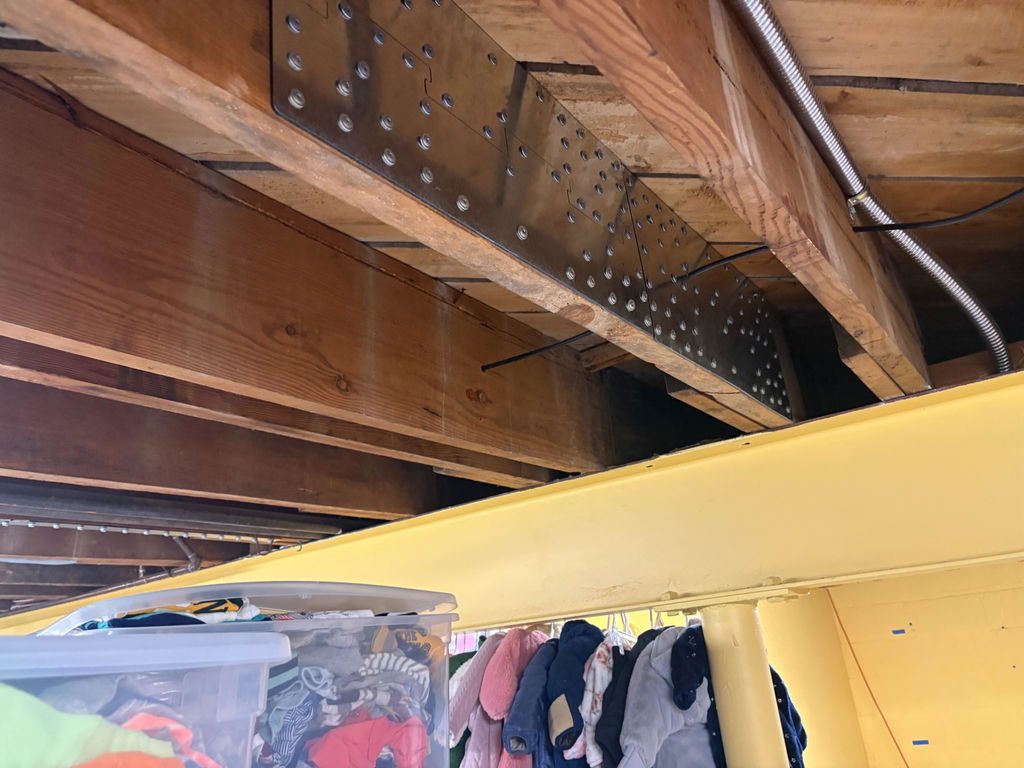
Before cutting a floor joist, confirm whether the proposed cut is permitted by the applicable building code and the joist manufacturer or project documents. Nolan’s Joist Repair Kit is a documented repair for a qualifying existing notch or hole in a dimensional-lumber joist; it is not blanket permission to make a new cut.
- Do not use a repair kit as advance approval for a proposed joist cut.
- First verify joist type, size, species, grade, span, spacing, loads, cut location, and required remaining wood.
- Nolan’s JRK report covers qualifying dimensional lumber under 10 psf dead load and 40 psf live load.
- When a documented existing notch or hole qualifies, use Nolan’s supplied table to select the strap length.
- Conditions outside the report require engineering review before cutting or repair.
Is every floor joist structural?
A floor joist supports floor loads and forms part of the building’s structural framing. The practical question is not whether the joist is “structural”; it is whether the proposed notch or hole is permitted for that specific joist and location.
Before cutting, identify:
- Dimensional lumber or an engineered product.
- Actual joist size.
- Species and grade.
- Clear span and spacing.
- Existing floor loads and any concentrated loads.
- Cut type, location, depth, and width.
- Existing notches, holes, deterioration, or previous repairs.
- Applicable code, manufacturer, and project requirements.
Do not replace those checks with a generic one-third rule, a visual load-path test, or an assumption that a short joist has spare capacity.
When does the Nolan Joist Repair Kit apply?
Nolan’s current governing design report analyzes qualifying dimensional-lumber floor joists of Douglas-Fir-Larch No. 2 and Spruce-Pine-Fir No. 2. For an unlisted species, contact Nolan Structural Products or a qualified design professional.
The report assumes:
- 10 psf dead load.
- 40 psf live load.
- Joist spans and spacing that satisfy the assumptions and span tables cited by the governing report.
- Verified joist size, species, documented notch or hole, and remaining wood.
- A correctly sized A36 steel strap installed beneath the qualifying notch or hole.
- All 32 ¼-inch-diameter × 2½-inch-long Simpson Strong-Tie SDS25212 structural screws installed in sound wood, with 16 at each end, as required by the current installation instructions.
The report states that its notch-repair analysis also applies to a hole of the same size because wood remains around the hole. This is an engineering conclusion within the report’s assumptions—not a general rule for every drilled joist.
How is strap length selected for an existing notch or hole?
Nolan directed use of the supplied sizing table:
| Strap length | Notch or hole width |
|---|---|
| 24 inches | Up to 6 inches |
| 30 inches | Up to 12 inches |
| 34 inches | Up to 16 inches |
| 42 inches | Up to 24 inches |
The longest kit is the 42-inch strap, which Nolan specifies for a documented notch or hole up to 24 inches wide.
Notch or hole width alone does not complete selection. The joist must also meet the governing report’s species, size, span, spacing, loading, remaining-wood, and fastening requirements.
How much wood must remain?
The report’s Table 2 gives these minimums above the notch:
| Joist size | DF-L No. 2 | SPF No. 2 |
|---|---|---|
| 2×6 | 1.8 inches | 2.3 inches |
| 2×8 | 2.4 inches | 3.0 inches |
| 2×10 | 2.9 inches | 3.8 inches |
| 2×12 | 3.4 inches | 4.4 inches |
Each value is tied to the report’s listed maximum span and load assumptions. If species, grade, size, span, spacing, load, or remaining wood cannot be verified, the current installation instructions require engineering review.
Does buying a kit make a proposed cut acceptable?
No. A repair product does not authorize a new opening or establish that a planned plumbing, wiring, duct, stair, wall, or equipment change is acceptable.
For a proposed cut:
- Review the current code and project requirements before cutting.
- Confirm whether the joist is within the JRK report.
- Obtain project-specific engineering when the proposed condition falls outside published criteria.
- Do not cut first and rely on the availability of a longer strap afterward.
This article intentionally does not provide generic notch-placement, hole-placement, sistering, shoring, or load-path instructions.
What if the joist is already cut?
Document the condition before choosing a repair:
- Photograph the full joist and both supports.
- Measure joist size, span, and spacing.
- Identify species and grade where possible.
- Measure the notch or hole width and location.
- Measure the wood remaining above the notch or hole.
- Record nearby loads, previous repairs, splits, decay, and obstructions.
- Confirm bottom-edge access and sound fastening wood.
If the existing notch or hole qualifies, the strap installs centered beneath it with equal fastening length on each side. Install 32 ¼-inch-diameter × 2½-inch-long Simpson Strong-Tie SDS25212 structural screws, with 16 installed into sound wood at each end.
When must you stop?
Stop and obtain engineering review if:
- The joist is not qualifying dimensional lumber.
- Species, grade, span, spacing, loads, or remaining wood cannot be verified.
- The required repair falls outside the sizing table or report.
- Wood is split, deteriorated, or cannot receive every screw.
- Straps would overlap.
- The proposed work changes the supported loads.
- Bottom-edge installation cannot follow the current instructions.
FAQ
Can I install a Joist Repair Kit before making a planned cut?
Do not treat the kit as permission to cut. Verify the proposed cut under the applicable code and project documents first.
What floor loading does the JRK report assume?
The report assumes 10 psf dead load and 40 psf live load.
Can the JRK repair a drilled hole?
The report states that its analysis applies to a hole of the same size within the report’s assumptions and limits.
How is the strap length selected?
Use Nolan’s supplied table: the 24-inch strap for a documented notch or hole up to 6 inches wide, 30 inches for up to 12, 34 inches for up to 16, and 42 inches for up to 24.
Can I use the kit when the joist species is unknown?
No automatic selection should be made. The current instructions require engineering review when species, grade, size, span, spacing, load, or remaining wood cannot be verified.
Does this article provide general joist-cutting rules?
No. Proposed cuts must follow the applicable current code, manufacturer instructions, and project documents.
One last thing
Use the JRK to evaluate a documented repair—not to justify an irreversible cut. Verify the proposed work first, and obtain engineering review whenever the joist or new opening falls outside Nolan’s published criteria.