How to Reinforce Floor Joists for a Home Gym
Share
A home gym can expose floor bounce that was less noticeable when the room held lighter furniture. Racks, weight plates, treadmills, and repeated movement can make an otherwise serviceable floor feel springy. Before adding equipment, separate two questions: whether the framing has adequate load capacity and whether the floor is stiff enough for the intended use.
The Floor Joist Stiffening Strap System is designed to increase the stiffness of existing wood joists and reduce deflection. It does not establish the allowable home-gym load by itself. The joists, span, spacing, supports, subfloor, equipment layout, and concentrated loads still need to be appropriate for the room.
- Confirm floor capacity separately from floor stiffness before placing gym equipment.
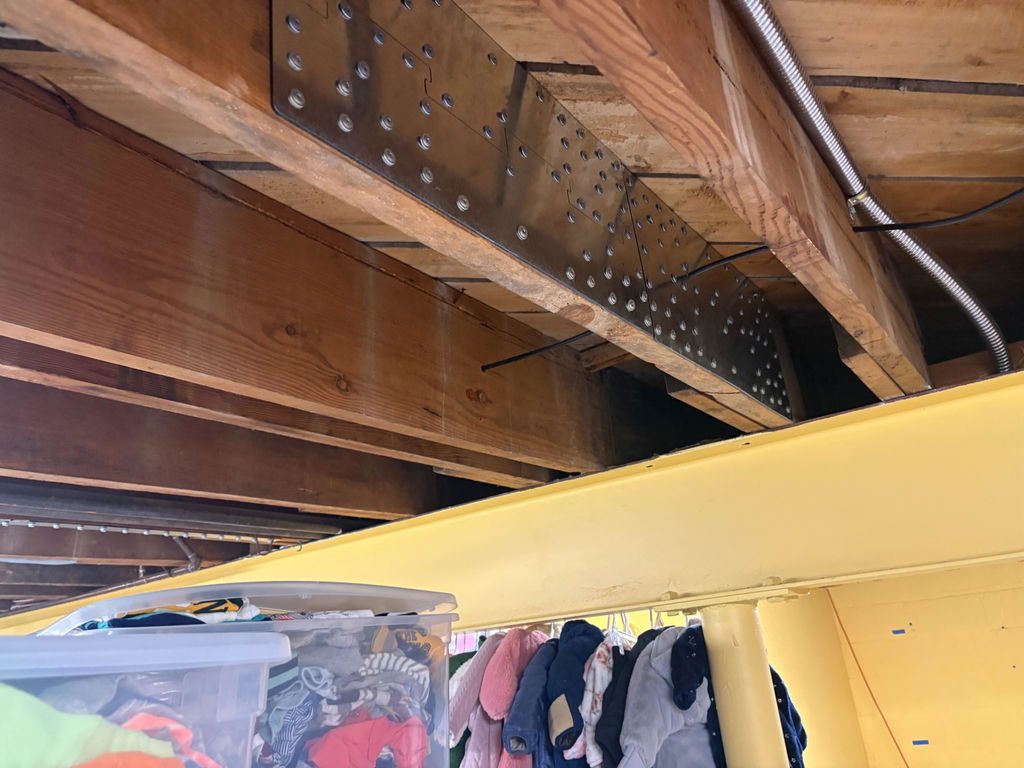
- The Floor Joist Stiffening Strap System fastens to the underside of existing wood joists.
- Galvanized A36 steel straps form a tension tie that reduces bending and flexing.
- Theoretical deflection reduction is 35–54%; measured test reduction is 15–53%, depending on joist size.
- Use the floor-joist design calculations and the actual framing configuration.
Start With the Home-Gym Load
List the equipment before selecting a reinforcement method. Include the weight of the rack, bench, machine, plates, dumbbells, storage system, and people using the room. Pay particular attention to equipment that puts substantial weight through small feet or closely spaced contact points.
A room’s total equipment weight is not enough to evaluate the framing. Where the weight sits matters. A concentrated load near the center of a joist span produces a different demand than the same load distributed across several joists or located closer to a support.
Record:
- Equipment weight and footprint
- Proposed equipment position
- Direction of the joists below the room
- Joist size and spacing
- Clear span between supports
- Existing bounce, sag, vibration, or unevenness
- Access to the underside of the joists
- Condition of the subfloor and supporting beams or walls
If the equipment manufacturer provides anchoring or floor requirements, include those in the review. Do not assume a less bouncy floor automatically has enough capacity for every machine or weight layout.
Capacity and Stiffness Are Different
Capacity concerns whether the floor framing can safely carry the applied loads. Stiffness concerns how much the floor bends, vibrates, or bounces under those loads.
A floor may have adequate strength but still feel springy. It may also feel firm while containing a localized condition that needs evaluation. For a home gym, both questions matter because exercise equipment can introduce static weight, concentrated loads, and repeated movement.
The Floor Joist Stiffening Strap System addresses stiffness and deflection by adding a steel tension element to the bottom of the joists. Its product documentation should not be used as a substitute for determining the allowable equipment load on the complete floor system.
How the Stiffening Strap System Works
Floor joists bend under load. As a joist bends, the bottom portion acts in tension. The galvanized steel strap attaches directly to the underside of the wood joist and forms a continuous tension tie that resists bending and flexing.
The system uses 3-foot and 4-foot strap sections so the material can be carried into confined spaces. Eight-inch connector straps join the sections to form a continuous steel band along the bottom of the joist. The straps are made from galvanized A36 structural steel and fastened through predrilled holes with the included 1/4-inch × 1-1/2-inch lag screws.
This underside installation can improve floor stiffness without adding a new beam or sistering lumber alongside every joist. The bottom of each joist must remain accessible for the specified strap and fastener layout.
Verified Performance by Joist Size
Nolan’s current design calculations separate theoretical deflection reduction from measured test results:
| Joist Size | Reinforced-to-Plain Stiffness Ratio | Theoretical Deflection Reduction | Measured Deflection Reduction | Reported Error |
|---|---|---|---|---|
| 2×4 | 2.20 | 54% | 49% | 5% |
| 2×6 | 1.92 | 48% | 53% | 5% |
| 2×8 | 1.77 | 43% | 31% | 12% |
| 2×10 | 1.64 | 39% | 15% | 24% |
| 2×12 | 1.55 | 35% | 20% | 15% |
The theoretical values show how the added steel changes calculated stiffness. The measured values are the report’s test results. Neither column is an equipment load rating. Use the complete floor framing and equipment layout to evaluate capacity.
When the System Fits a Home-Gym Project
The system may be relevant when accessible dimensional-lumber joists have adequate structural capacity but exhibit noticeable bounce or deflection.
A suitable project generally has:
- Accessible dimensional-lumber floor joists covered by the design documentation
- Access to the bottom of the joists
- A measurable bounce or deflection concern
- A framing layout covered by the floor-joist design calculations
- Sound wood at the required screw locations
- Space for a continuous strap along each selected joist
The system is intended for accessible dimensional-lumber floor joists within the documented application. If the joist type, span, loading, or installation differs from that scope, obtain a project-specific review.
What Comes With the System
The current product documentation identifies the main components:
- Floor Joist Stiffening Straps in 3-foot or 4-foot lengths
- Eight-inch connection straps for joining strap sections
- 1/4-inch × 1-1/2-inch lag screws
The product is made to order based on the accessible joist length and applicable length table. Confirm the necessary footage from the selected joists and approved layout before ordering.
Installation Documentation
The documented system uses 3-foot and 4-foot straps with 8-inch connector straps to form a continuous steel band along the underside of the joist. Nolan’s current design calculations specify predrilled 1/4-inch holes at 2 inches on center.
Follow Nolan’s current installation instructions and applicable length table for all installation details, including the complete fastening pattern, connector layout, strap length, and joists included in the work. Do not create a universal home-gym spacing rule or assume every joist in every room uses the same quantity of steel.
Planning the Equipment Layout
Once the framing has been evaluated, place the heaviest equipment according to the approved floor plan. The equipment footprint should be considered relative to joist direction and support locations.
A rack with closely spaced feet can create concentrated reactions. Plate storage may place more weight in a small area than the exercise station itself. A treadmill or other moving equipment can make vibration more noticeable even when its total weight is lower than a rack and plate set.
Rubber flooring can protect finishes and reduce impact noise, but it does not increase joist capacity or replace structural reinforcement. Keep finish selection separate from the framing evaluation.
Conditions Requiring Further Review
Request a structural review when:
- Joist size, spacing, or span cannot be confirmed
- The equipment load or footprint is unknown
- The floor has visible sag or permanent deformation
- The supporting beam, wall, or bearing condition is uncertain
- Moisture, decay, fire, or insect damage is present
- Required strap or screw locations are obstructed
- The framing falls outside the available floor-joist design calculations
- The room will contain unusually heavy or dynamic equipment
The correct sequence is to confirm the existing structure, determine the equipment loads, verify capacity, and then address stiffness. Do not use a stiffness percentage as proof that the floor can carry a proposed rack or machine.
Ordering Information
The Floor Joist Stiffening Strap System is made to order based on the accessible joist length and applicable length table. The product page gives pricing of $18 per foot and directs customers to call to place an order. Allow 14–21 business days for order processing.
Before ordering, have the joist measurements, selected joist count, required continuous strap lengths, and any project-specific documentation available. This avoids estimating footage from room dimensions alone.
FAQ
Can the Floor Joist Stiffening Strap System reduce home-gym floor bounce?
Yes. The system attaches to the underside of existing wood joists to increase stiffness and reduce deflection within the documented framing configurations.
Does the system establish how much gym equipment the floor can hold?
No. Equipment capacity depends on the complete floor system, including joists, span, spacing, supports, subfloor, equipment position, and concentrated loads.
What joist sizes are covered by the performance table?
The table lists 2×4, 2×6, 2×8, 2×10, and 2×12 joists, with the reported stiffness increase and deflection reduction varying by size.
Where are the straps installed?
They align along the underside of existing wood joists and form a continuous steel tension band using modular straps and 8-inch connectors.
What fasteners are included?
The current product documentation identifies 1/4-inch × 1-1/2-inch lag screws. Follow Nolan’s current installation instructions for the complete fastening pattern and installation details.
Can rubber gym flooring replace joist reinforcement?
No. Rubber flooring protects finishes and may reduce impact noise, but it does not increase the structural capacity or stiffness of the joists.
How is the system ordered?
It is made to order based on the accessible joist length and applicable length table, priced at $18 per foot, and ordered by phone. The listed processing time is 14–21 business days.
One Last Thing
For a home gym, start with the actual equipment and framing—not a generic room-load assumption. Confirm capacity first, then use the Floor Joist Stiffening Strap System where the documented goal is to reduce bounce and deflection in the existing wood-joist floor.